Launch offer — valid today only

The Easiest Way to Learn Welding and Get Ready for Your Cert Test Explained with Pictures

Polarity, PPE, stick, MIG, flux core, TIG, joints and positions, weld symbols, defects and the bend test: in your notes it's a wall of text. Here every topic fits on one page, with the drawing and what you need to remember. 70 illustrated pages.

I WANT TO LEARN IT WITH PICTURES

🔒 Secure checkout · PDF by email · 30-day guarantee

One topic per pagethe drawing shows you the process and the text backs it up
70 illustrated pages9 parts, from what welding is to test day
Up-to-date sourcesAWS A3.0 and A2.4, AWS D1.1 and OSHA 1910 Subpart Q

This Is What the Pages You Will Study Look Like

One topic per page, the drawing that shows you how it's done and the boxes with what you need to know:

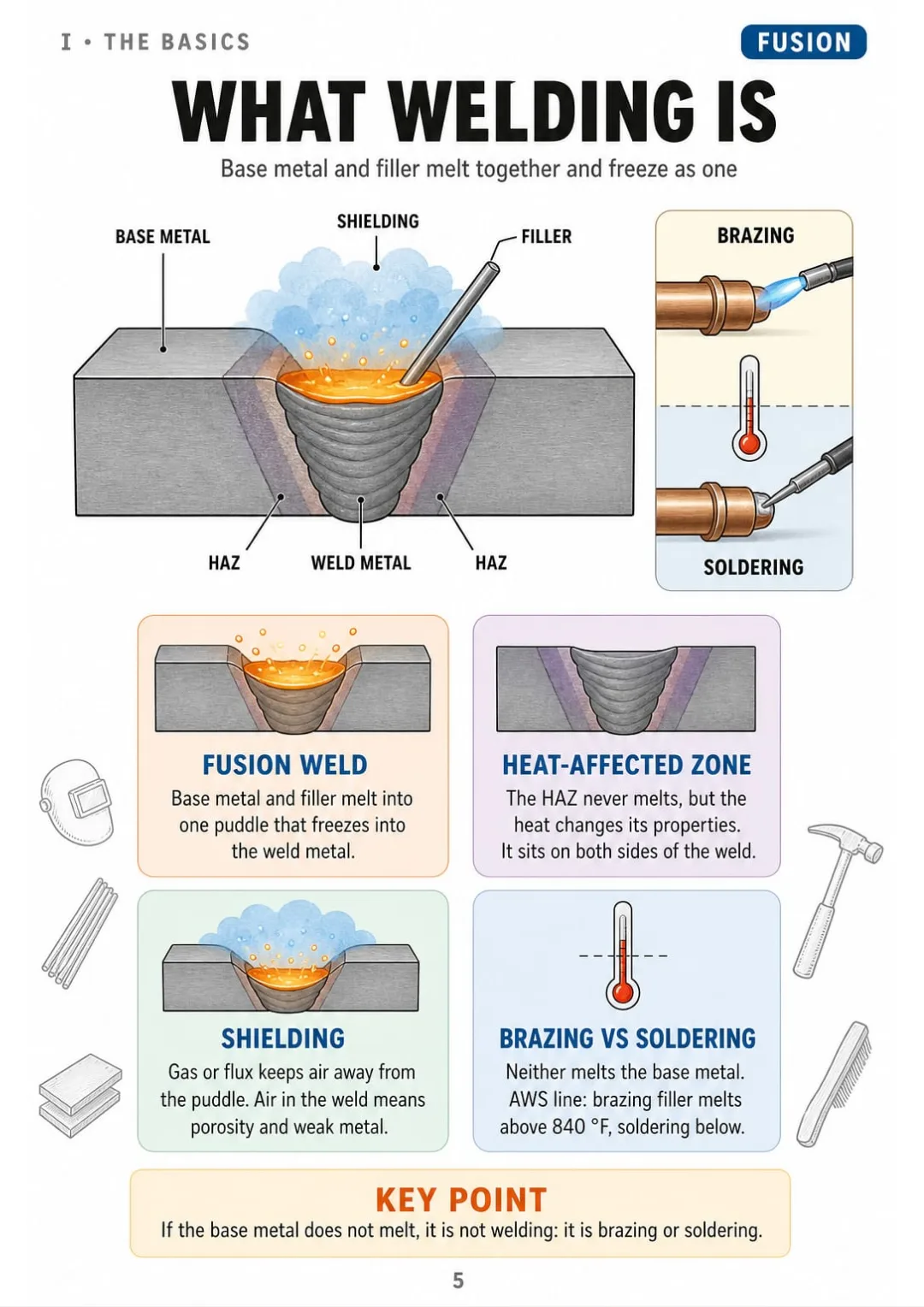
Weld metal, HAZ and shielding in one cross-section, plus the 840 °F brazing line
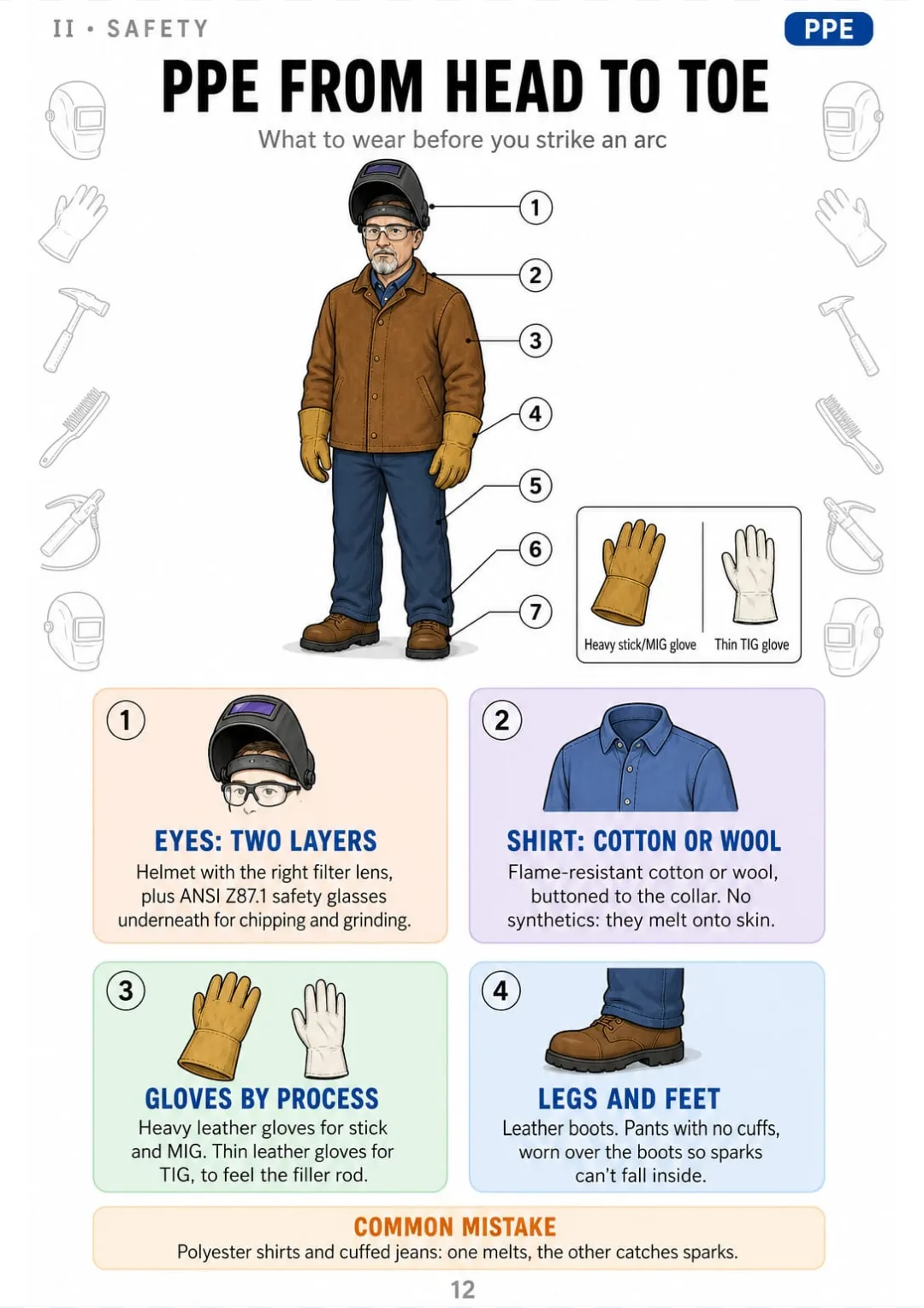
Helmet, Z87.1 glasses, FR cotton, leather gloves, jacket, boots, cuffless pants.
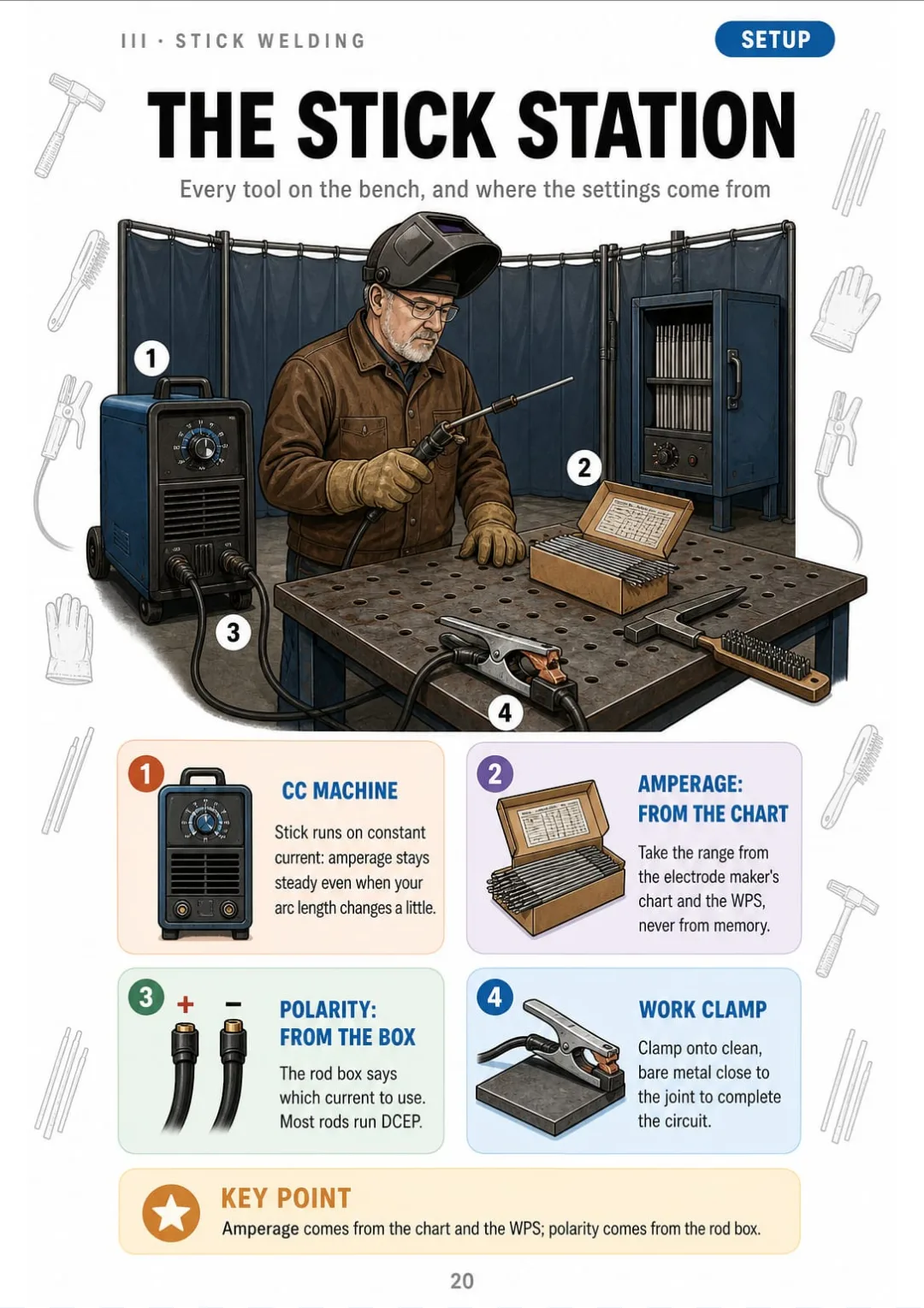
CC machine, stinger, work clamp, rods, oven: amperage from the chart, polarity from the box.
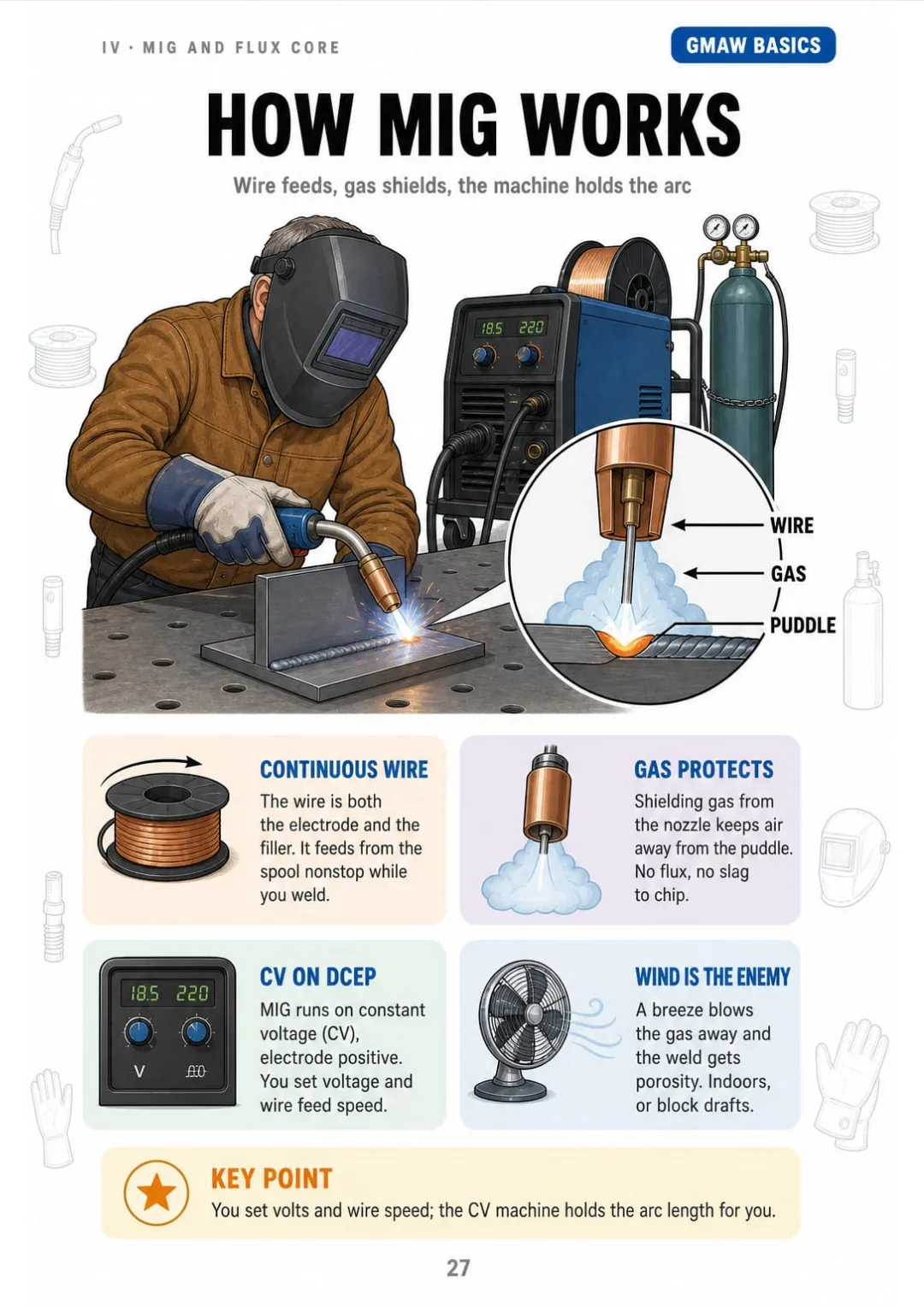
MIG = continuous wire + shielding gas + CV power on DCEP
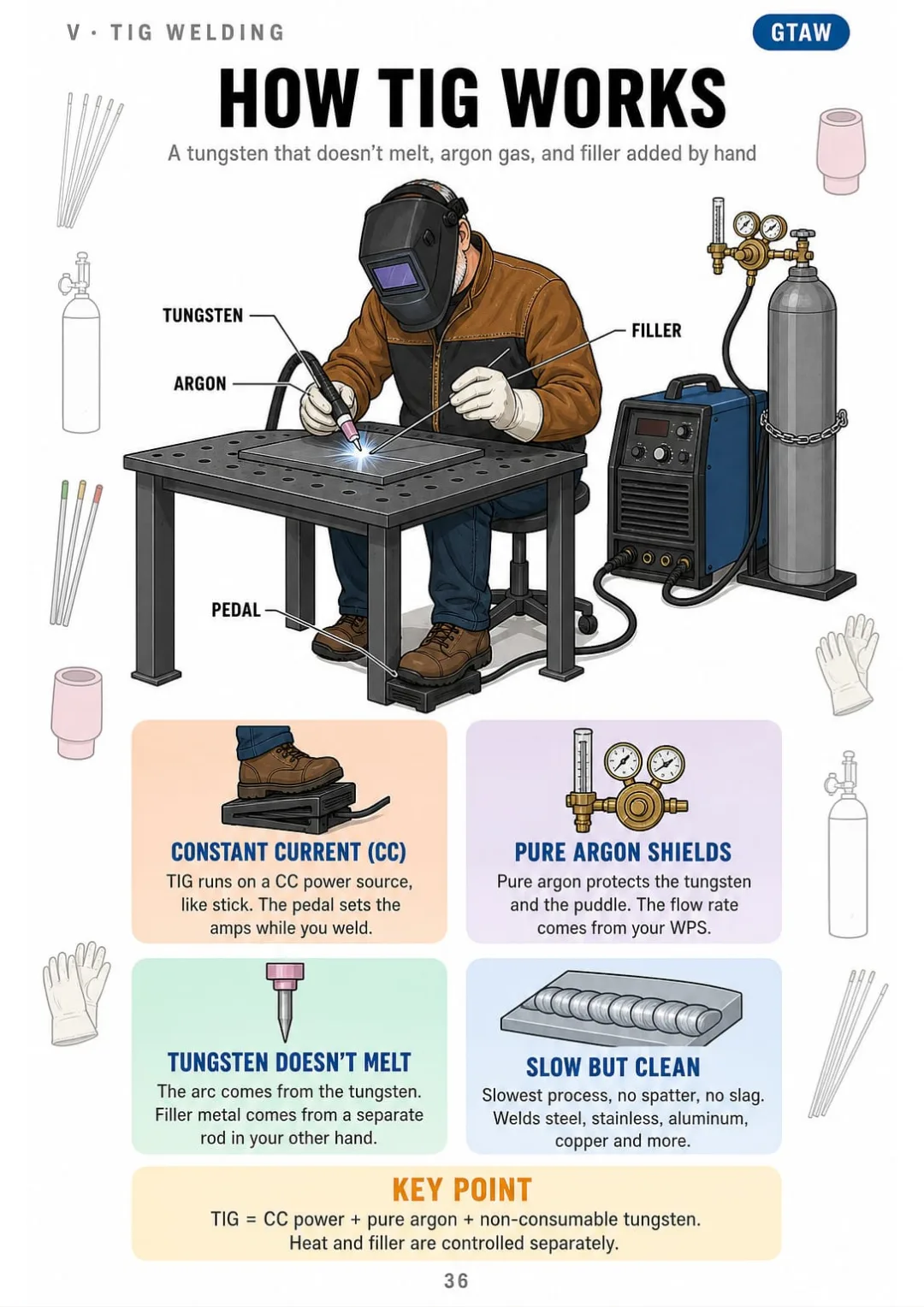
TIG on one drawing: CC power, pure argon, tungsten, filler rod and foot pedal.
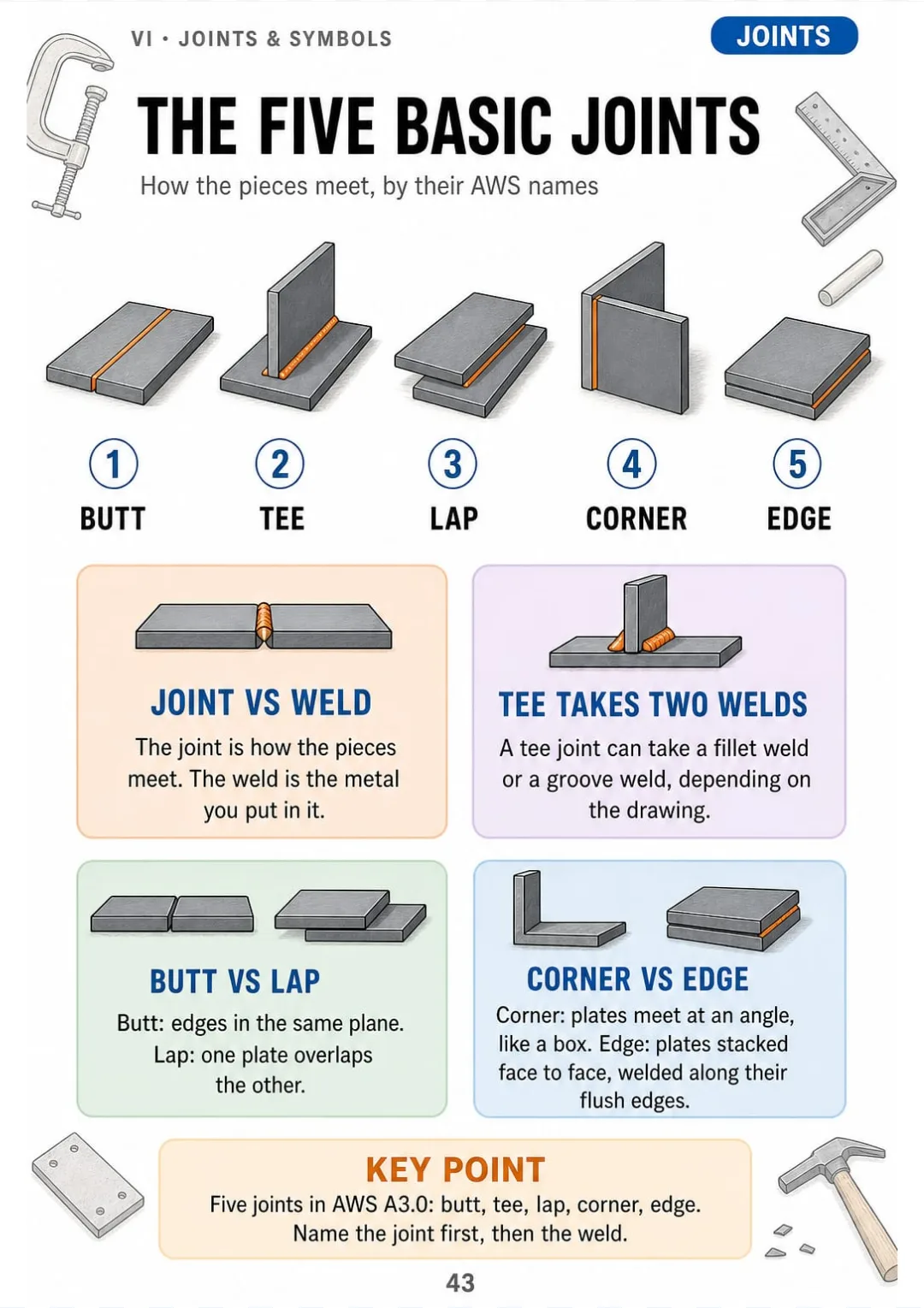
The 5 AWS basic joints in 3D: butt, tee, lap, corner and edge.
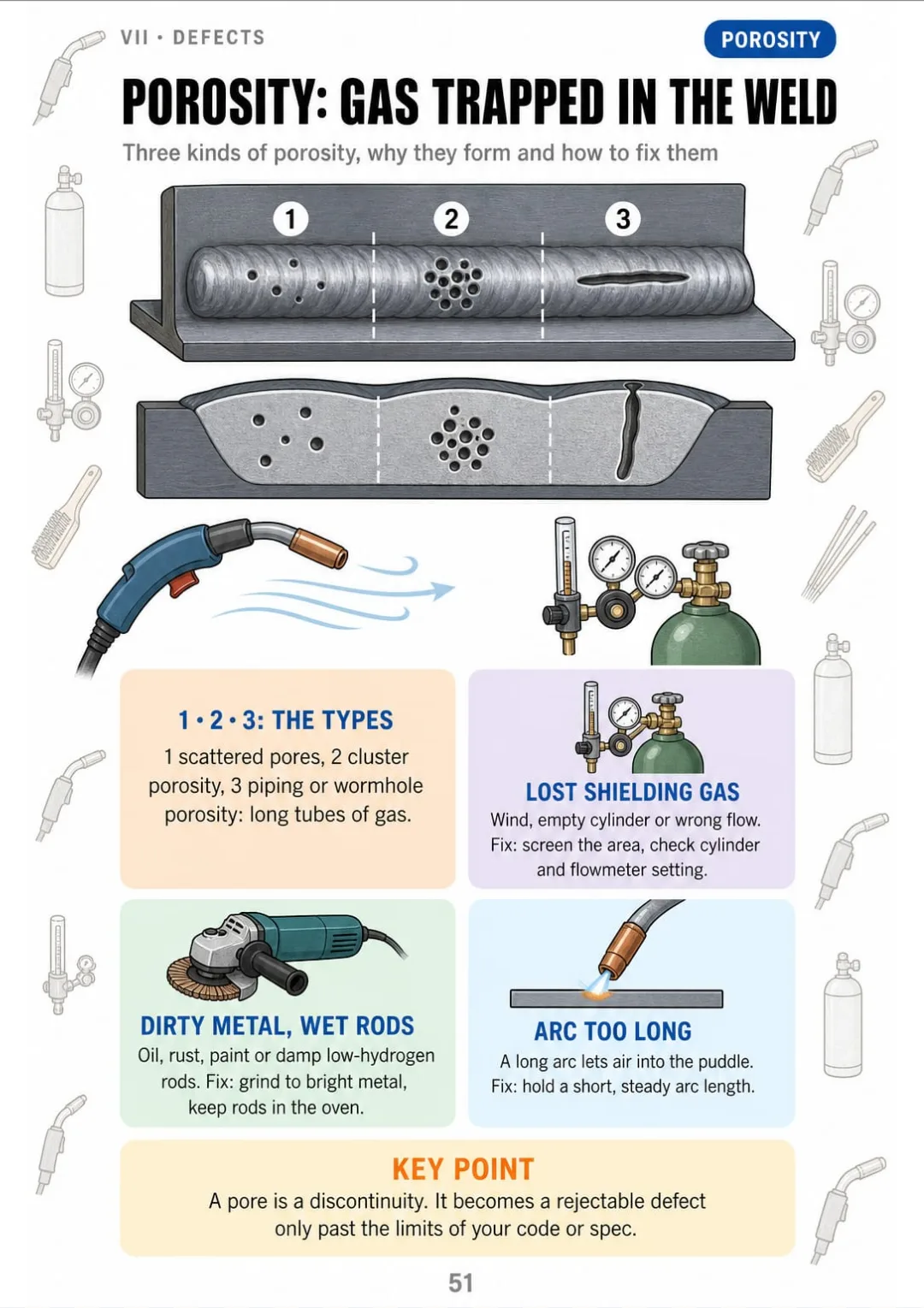
Scattered, cluster and piping porosity: shielding, clean metal, dry rods, short arc.
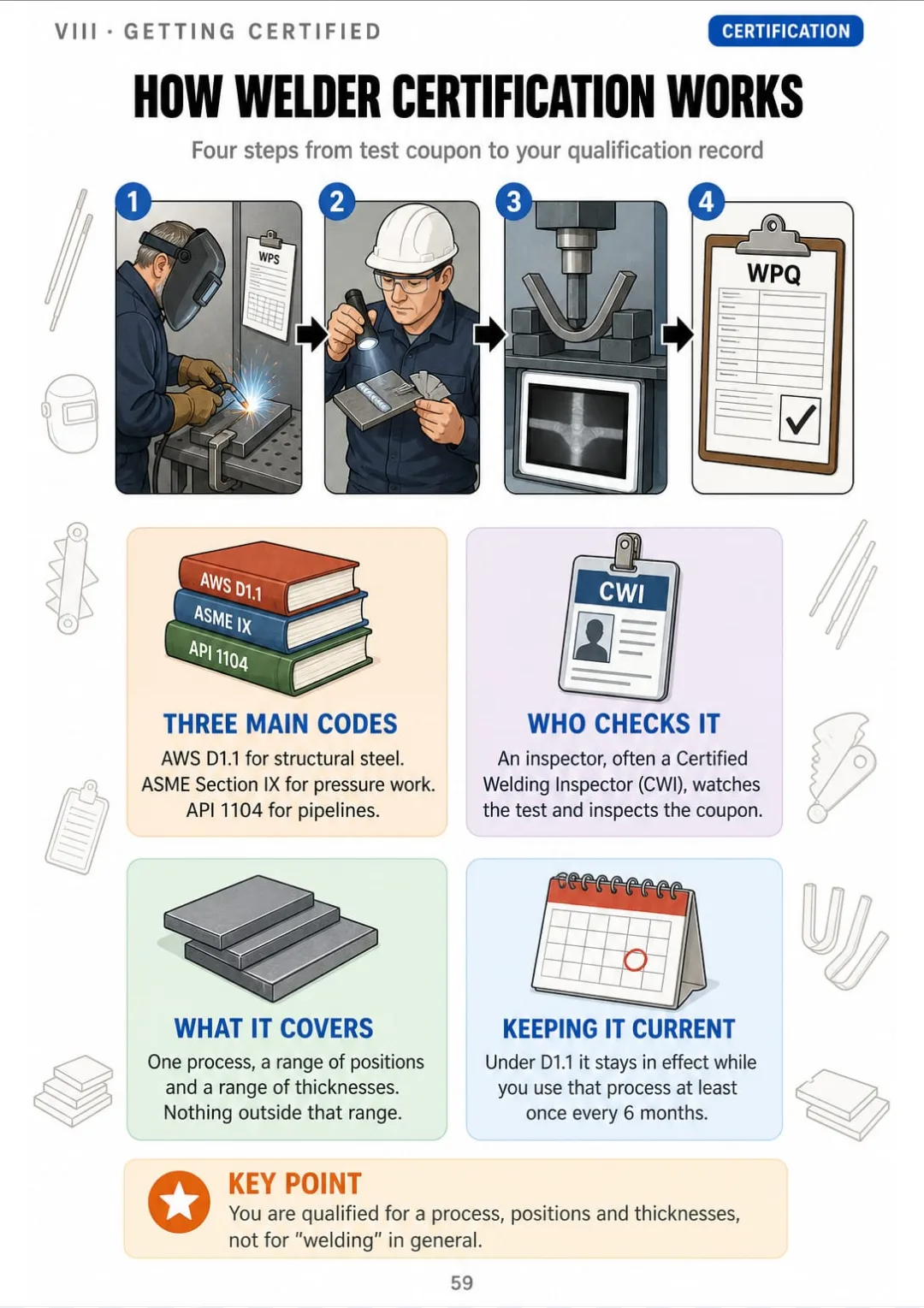
Coupon → inspector → visual and bend tests → WPQ: D1.1, ASME IX, API 1104

Swipe to see more →

These are real pages from the book. The table of contents is the full one: 9 parts and 66 topics.

It's Not Your Memory. Nobody Put It in Order for You.

You've read the stick setup three times. You close your notes...

...and you can't remember where the work clamp goes or where the amperage comes from. It was just lines of text.

CC machine, stinger, work clamp, rods, oven: amperage from the chart, polarity from the box.

Here the stick station is one page, every piece drawn in place: the CC machine, the stinger, the work clamp, the rods and the rod oven, with amperage from the manufacturer's chart and polarity printed on the rod box.

And on the pages next to it, every process gets its own: MIG, flux core, TIG, the five basic joints and the bend test.

First you understand why it's set up that way. Then the setup comes back on its own.

SEE THE DIFFERENCE

Stop Memorizing Rules You Can't Picture:

THIS
  • Pages and pages of cramped text
  • Processes without a single drawing
  • On test day, you don't know where to start
Personal protective equipment for arc welding shall be selected according to the hazards present. Operators shall wear a welding helmet with a filter lens of suitable shade number over safety spectacles meeting ANSI Z87.1. Flame-resistant clothing of wool or heavy cotton, free of oil and grease, shall cover all exposed skin. Trousers should be worn without cuffs and over the tops of boots. Leather gauntlet gloves, leather jackets and high-top safety footwear are recommended against sparks, spatter and radiation.
FOR THIS
  • Every process drawn
  • One topic per page, with the rules in boxes
  • You remember it because you've seen it
Helmet, Z87.1 glasses, FR cotton, leather gloves, jacket, boots, cuffless pants.
CONTENTS

Take a Look at the 9 Parts and 66 Topics

The basics, safety, stick, MIG and flux core, TIG, joints, positions and symbols, defects and inspection, getting certified, and review and practice: 70 pages, all illustrated

IThe Basics · pp. 5-11
  1. What welding is
  2. The main processes
  3. The welding circuit
  4. Power sources
  5. Polarity: DCEP, DCEN and AC
  6. Metals you will weld
  7. Part I review
IISafety · pp. 12-19
  1. Personal protective equipment
  2. Choosing a lens shade
  3. Arc rays: eyes and skin
  4. Welding fumes
  5. Fire and hot work
  6. Electric shock
  7. Gas cylinders
  8. Part II review
IIIStick Welding (SMAW) · pp. 20-26
  1. The stick setup
  2. Reading a stick electrode
  3. Keeping low-hydrogen rods dry
  4. Striking the arc
  5. CLAMS: five things to control
  6. Slag, restarts and craters
  7. Part III review
IVMIG and Flux Core · pp. 27-35
  1. How MIG works
  2. The machine, part by part
  3. Shielding gas
  4. Transfer modes
  5. Voltage, wire speed, stickout
  6. Push or drag
  7. Flux-cored wire
  8. MIG troubleshooting
  9. Part IV review
VTIG Welding (GTAW) · pp. 36-42
  1. How TIG works
  2. The TIG torch
  3. Tungsten electrodes
  4. DCEN or AC
  5. Two hands and a pedal
  6. Stainless steel and back purging
  7. Part V review
VIJoints, Positions, Symbols · pp. 43-50
  1. The five basic joints
  2. Groove preparations
  3. Fillet welds
  4. Welding positions
  5. Root, fill and cap
  6. Shrinkage and distortion
  7. Reading weld symbols
  8. Part VI review
VIIDefects and Inspection · pp. 51-58
  1. Porosity
  2. Cracks
  3. Incomplete fusion and penetration
  4. Undercut, overlap and profile
  5. Slag and tungsten inclusions
  6. Nondestructive testing
  7. The bend test
  8. Part VII review
VIIIGetting Certified · pp. 59-63
  1. How welder certification works
  2. WPS and PQR
  3. The test plate
  4. Test day
  5. Part VIII review
IXReview and Practice · pp. 64-70
  1. Final review: numbers to know
  2. Glossary
  3. Practice set 1: questions 1–5
  4. Practice set 1: questions 6–10
  5. Practice set 2: questions 11–15
  6. Practice set 2: questions 16–20
  7. Answers and explanations

What If Every Topic Fit on a Single Page?

Imagine this:

Instead of rereading half a page on polarity without being able to picture it...

...you open the page and find DCEP, DCEN and AC drawn side by side, with where the heat goes and which process uses each one.

TIG on one drawing: CC power, pure argon, tungsten, filler rod and foot pedal.

And PPE, stick, MIG, TIG, weld symbols and the bend test turn into drawings and tables you can read at a glance.

You stop cramming and start understanding.

That's exactly what Welding Made Visual does. It's not “just another manual.” It's 70 pages in 9 parts: 51 illustrated topics, one per page, then 20 practice questions with explained answers, a final review of the numbers to know and a glossary. Because what your brain sees in order, it remembers.

Because what your brain sees organized, it remembers.

Here Is What You Get with Welding Made Visual:

Ipp. 5-11

The Basics

What welding is, the main processes, the welding circuit, power sources, DCEP, DCEN and AC polarity, and the metals you'll weld.

IIpp. 12-19

Safety

PPE from head to toe, choosing a lens shade, arc rays, fumes, fire and hot work, electric shock and gas cylinders.

IIIpp. 20-26

Stick Welding (SMAW)

Set up the stick station without guessing: read an electrode like E7018, keep low-hydrogen rods dry, strike the arc, use CLAMS and handle slag, restarts and craters.

IVpp. 27-35

MIG and Flux Core

How MIG works, the machine part by part, shielding gas, transfer modes, voltage, wire speed and stickout, push or drag, flux-cored wire and troubleshooting.

Vpp. 36-42

TIG Welding (GTAW)

How TIG works, the torch, tungsten electrodes, DCEN or AC, two hands and a pedal, stainless steel and back purging.

VIpp. 43-50

Joints, Positions, Symbols

The five basic joints, groove preps, fillet welds, positions from 1G to 6G, root, fill and cap, distortion and reading weld symbols.

VIIpp. 51-58

Defects and Inspection

See a defect and know its cause: porosity, cracks, incomplete fusion and penetration, undercut, overlap, slag and tungsten inclusions, nondestructive testing and the bend test.

VIIIpp. 59-63

Getting Certified

Walk into the test knowing the steps: how welder certification works, WPS and PQR, the test plate and what happens on test day.

IXpp. 64-70

Review and Practice

The numbers to know, a glossary, 20 practice questions in two sets and every answer explained.

At the end of the book: 20 practice questions with explained answers, the numbers to know and a glossary.
And That Is Not All: 2 More Books, Free

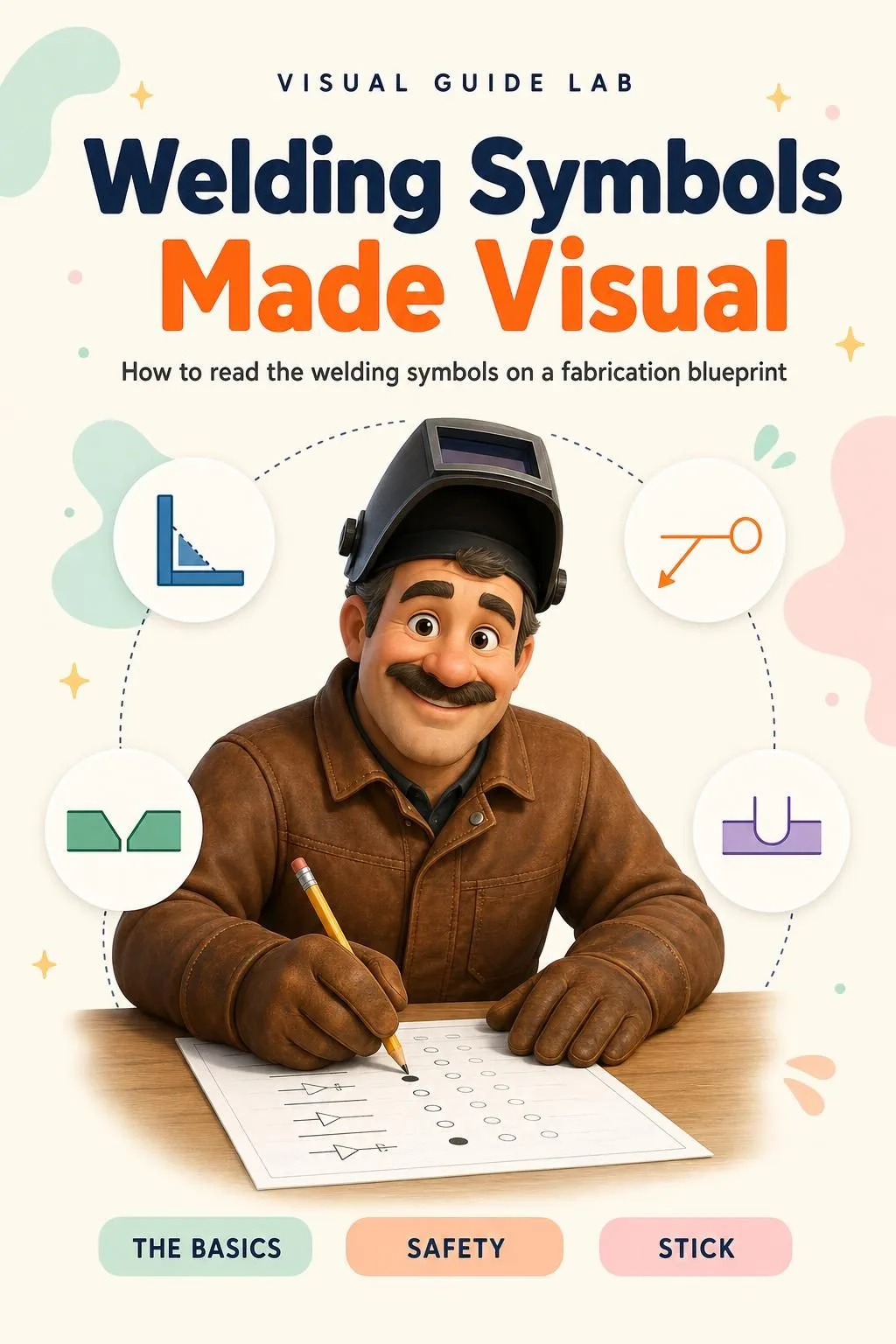
Welding Symbols Made Visual

BONUS 1: «Welding Symbols Made Visual»

Value on its own: US$ 17.90

How to read the welding symbols on a fabrication blueprint: the arrow, the reference line, the weld symbols and the dimensions, with examples to read and the answers, so you know exactly which weld the print calls for.

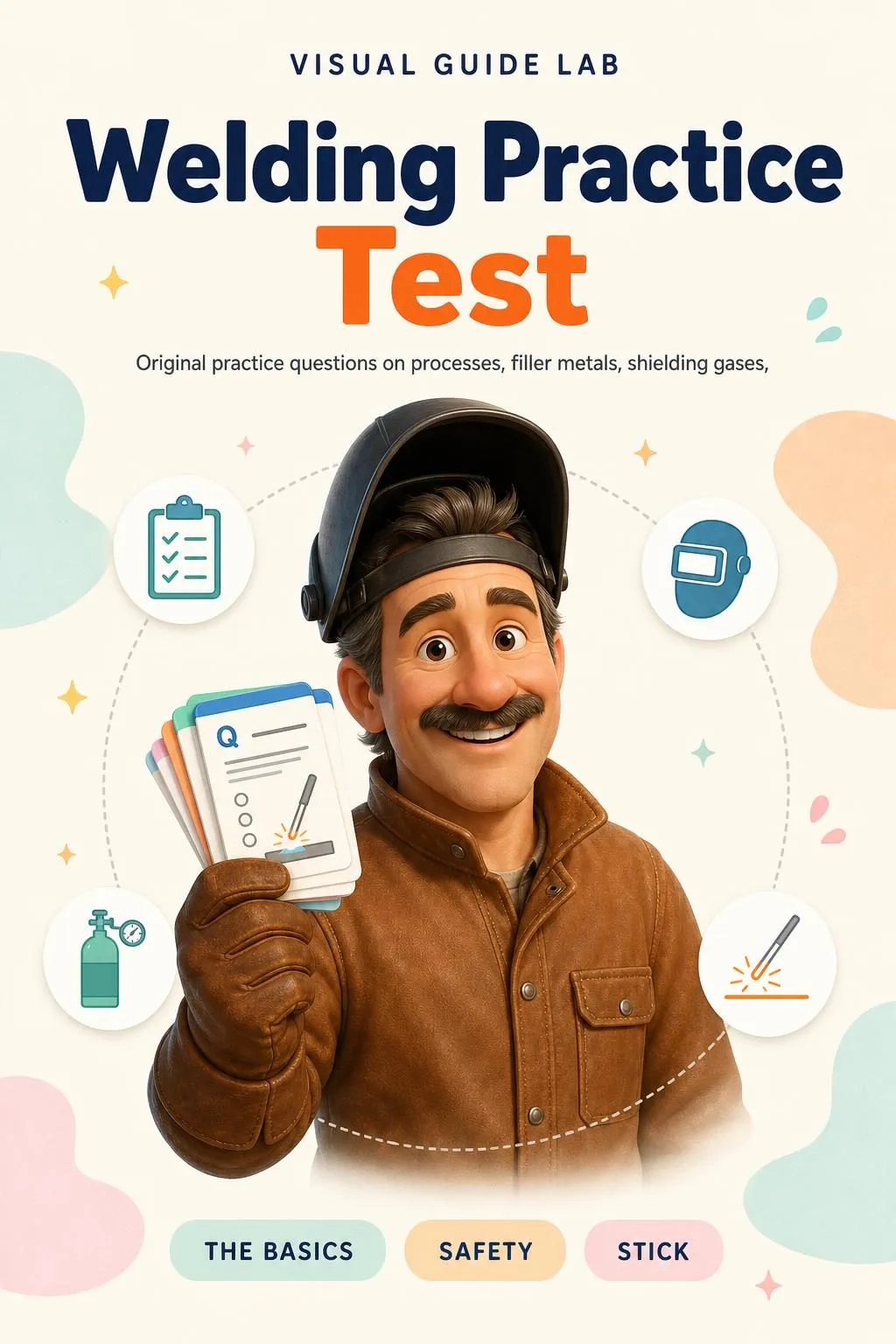
Welding Practice Test

BONUS 2: «Welding Practice Test»

Value on its own: US$ 14.90

Original practice questions on processes, filler metals, shielding gases, joints and positions, symbols, defects, inspection and safety, with every answer explained, so you know why it is right and what to review when you miss one.

Welding Made Visual + 2 Free Books

  • Welding Made Visual: 70 illustrated pagesUS$ 63
  • BONUS 1: Welding Symbols Made VisualUS$ 17.90
  • BONUS 2: Welding Practice TestUS$ 14.90
  • High-resolution PDF to printIncluded
Total value US$ 95.80
YOUR PRICE:
US$ 27
You save US$ 68.80
YES, I WANT WELDING MADE VISUAL FOR US$ 27

📄 This is a digital PDF book sent to your email: nothing is printed or shipped.

Secure purchaseEncrypted payment30-day guarantee

PDF by email: Welding Made Visual reaches your inbox as a PDF, and the two free books come by email too. One-time payment, no installments or hidden costs.

Is This Book for You?

You're in welding school

You're in welding school

Stick, MIG, flux core and TIG, one topic per page, to review between class and booth time.

Your cert test is coming up

Your cert test is coming up

Positions, WPS and PQR, the test plate and the bend test, plus 20 practice questions with the answers explained.

You already weld at home or on the job

You already weld at home or on the job

What your machine is doing, how gas and flux core work, how to work safe and why a bead fails, drawn page by page.

To Sum Up: Here Is What You Get

US$ 95.80US$ 27
YES, I WANT WELDING MADE VISUAL FOR US$ 27

📄 This is a digital PDF book sent to your email: nothing is printed or shipped.

30DAYS
GUARANTEE

30-Day Guarantee

30-day guarantee: tell us what didn't work and we'll refund 100%.

You have 30 days to try Welding Made Visual and the two bonus books. If a file does not open, if the content is not what this page describes, if you were charged twice or the download never arrived, write to us and we refund you in full. One payment, no subscription, no surprises.

Frequently Asked Questions

How do I get it?

As a high-resolution PDF by email, sent to the address you enter at checkout. Read it on your phone, tablet or computer, or print it. The two bonus books, Welding Symbols Made Visual and Welding Practice Test, come by email too, also as PDFs.

Is it a monthly or one-time payment?

One-time payment of $27. No installments, no subscription.

Who is it for?

For welding school and community college students, for anyone with a cert test coming up and for people who weld at home, on the farm or in maintenance and want a visual review. It starts from the basics. Check the table of contents above.

What sources is it based on?

The American Welding Society terms, symbols and classifications (AWS A3.0, A2.4, A5.1, A5.18, A5.20 and A5.12), the AWS D1.1 Structural Welding Code – Steel, and ANSI Z49.1 and OSHA 29 CFR 1910 Subpart Q for safety. Units are inches, psi and °F.

Is this official AWS material?

No. It's an independent study book. It isn't published by, affiliated with or endorsed by AWS, OSHA, ANSI or any certifying body, and it doesn't give you a certificate. You get certified by welding a test plate that an inspector or your employer evaluates; the book explains how that works and what they look for.

Does it replace welding school or hands-on training?

No. Welding is learned under the hood. The book explains what you're looking at; it doesn't replace your instructor, booth time, the WPS or your employer's procedures. It doesn't give you amperage or voltage numbers, on purpose: those come from your WPS and from your rod or wire manufacturer's chart. What the book shows is what each setting does and what changes in the bead when you move it.

Are the practice questions from the actual cert test?

No. The 20 questions in the book and the ones in Welding Practice Test are written for this book, not taken from any certification test. They help you check the theory: joints, positions, symbols and defects. Passing the plate takes practice under the hood.

Can I print it?

Yes. It's a high-resolution PDF: print the whole book or just the pages you want to keep in the shop.

What if I don't like it?

You have 30 days: if a file does not open, if the content is not what this page describes, if you were charged twice or the download never arrived, write to us and we refund you.

One Last Thing Before You Decide...

You don't have to reread the same page hoping it sticks this time.

You don't have to memorize codes and settings you can't picture.

And you definitely don't have to walk into the test not knowing where to start.

There's an easier way. And it's one click away. Now it's your turn.

One-time payment: US$ 27 · Guarantee: 30 days · PDF by email

YES, I WANT WELDING MADE VISUAL FOR US$ 27

📄 This is a digital PDF book sent to your email: nothing is printed or shipped.